 ultimate-guide
Mobile Car Audio Repair Service Near Me: What to Expect
Table of Contents
- Why Mobile Car Audio Repair Beats a Shop Visit
- Mobile Car Audio Installation Cost: What Drives the Number
- Troubleshooting Car Audio System Issues Before You Book
- How to Choose a Car Audio Technician You Can Trust
- Component Compatibility: Will New Gear Work With Your Vehicle?
- On-Site Repair Logistics: Scheduling, Workspace, and Timing
- Warranty Coverage and Follow-Up After a Mobile Install
- Frequently Asked Questions
Last Updated: October 1, 2026
Why Mobile Car Audio Repair Beats a Shop Visit
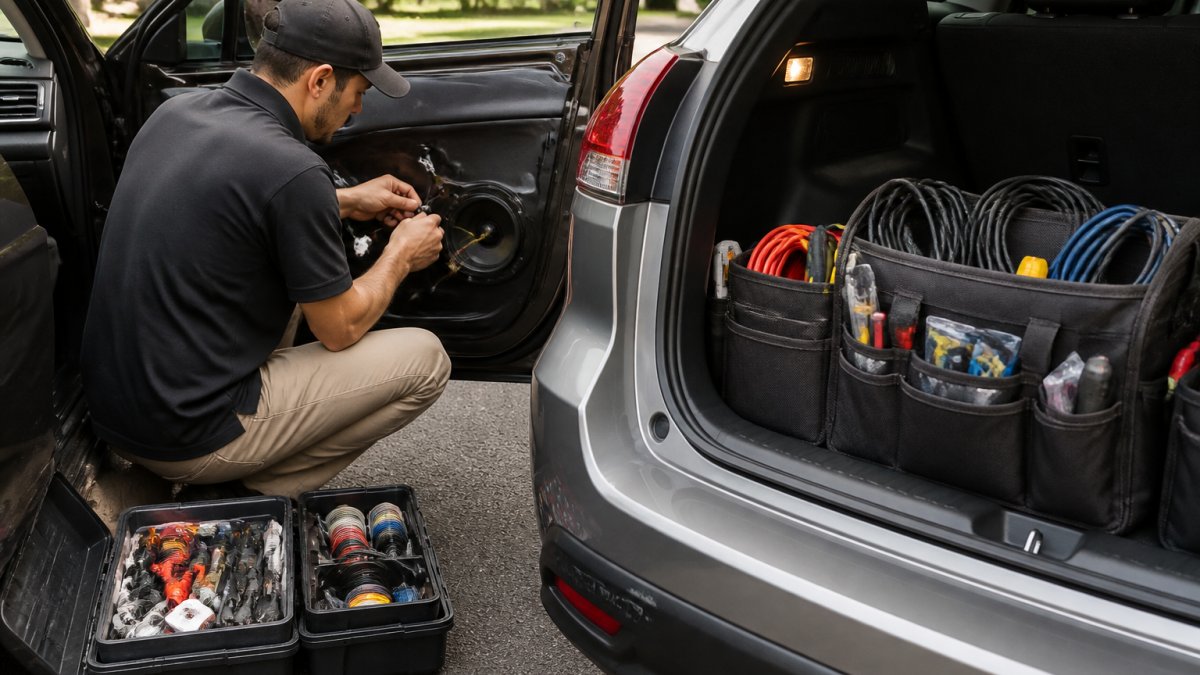
A mobile car audio repair service near me search usually starts the same way: something in your dashboard quit working, and you don't want to surrender your car for a day. Mobile car audio repair brings the technician, tools, and test equipment to your driveway or office parking lot, so the vehicle never leaves your sight.
What a Mobile Technician Actually Brings to Your Driveway
A properly equipped mobile technician arrives with more than a toolbox: a digital multimeter, tone generator, oscilloscope or signal tester, trim removal tools, crimpers, heat shrink, and a laptop for firmware and head unit configuration. That kit matters because car audio faults are rarely obvious, a crackling speaker could be a failing voice coil, a corroded ground, or a loose harness connector. Diagnosing it requires measurement, not guesswork.
Mobile Car Audio Installation Cost: What Drives the Number
Pricing for mobile car audio installation depends on three variables: labor complexity, parts, and travel. A speaker swap with easy door panel access takes far less time than the same job with integrated trim clips and hidden fasteners, and head unit replacement with Apple CarPlay or Android Auto integration adds wiring harness adapters, a dash kit, and possibly a steering wheel control module.
| Cost Driver | What Affects It | Typical Impact |
|---|---|---|
| Vehicle trim level | Luxury interiors need specialized trim tools | Higher labor time |
| Integration needs | CarPlay, Android Auto, factory amp retention | Added harness and module parts |
| Component type | Speakers vs. amplifier vs. subwoofer | Varies by parts and wiring runs |
| Travel distance | Distance to your home or office | May add a service call fee |
Troubleshooting Car Audio System Issues Before You Book
Troubleshooting car audio system issues at home can save you a service call, or at least help the technician diagnose faster. Start with the simplest checks.
- No sound from one speaker: Check the balance and fade settings first. A fader accidentally pushed to the front can mimic a dead rear speaker.
- Intermittent cutting out: Loose connections are the usual cause. Bumps in the road that trigger the fault point to a harness or ground issue.
- Static or crackling: Often a failing speaker or a corroded connection. If it changes with volume, suspect the speaker itself.
- No power at all: Check the fuse for the head unit. A blown fuse is cheap to replace and easy to rule out.
- Bluetooth or connectivity issues: Try deleting and re-pairing the device, and check for a firmware update for the head unit.
When a Repair Makes Sense and When You Need a Replacement
Repair usually wins when the fault is isolated: one blown speaker, a corroded ground, a failed amplifier channel. Replacement makes more sense when the head unit is a decade old and lacks features you want anyway, if you're already paying labor to pull the dash apart, upgrading to a modern unit with CarPlay and Android Auto often costs marginally more than reinstalling the old one.
How to Choose a Car Audio Technician You Can Trust
Choosing a car audio technician comes down to three things: verifiable experience, a clear diagnostic process, and a willingness to explain the work. Ask how long they've been doing this, whether they carry insurance, and what happens if something fails after the install.
A few specific questions separate professionals from hobbyists:
- Can you describe your diagnostic process for an intermittent fault?
- Do you carry liability coverage for damage to vehicle interiors?
- What's your policy if a component fails within the warranty period?
- Will you show me the old parts after removal?
Component Compatibility: Will New Gear Work With Your Vehicle?
Component compatibility is where most DIY installs go wrong, and it is the single biggest reason a mobile technician asks for your year, make, model, and trim level before quoting a job. Modern vehicles route audio through factory amplifiers, data bus networks, and integrated infotainment systems, so dropping in an aftermarket head unit without the right interface module can disable steering wheel controls, kill the factory amplifier, silence the door chimes, or trigger warning lights.
The Four Compatibility Questions That Decide the Job
Before buying anything, answer these in order. Each one changes what parts the technician needs to bring.
- Does the vehicle have a factory amplifier? Many vehicles, especially those with premium audio packages, use a separate factory amp that needs a specific interface to stay functional with an aftermarket head unit. Skip the interface and you either lose sound entirely or lose the amp's output.
- Does the radio share a data bus with other systems? Steering wheel controls, backup camera feeds, climate displays, and warning chimes often run through the same network as the radio. A vehicle-specific interface module (brands like Maestro, iDatalink, and PAC are common) translates between the aftermarket head unit and that network.
- What is the physical fitment? Dash kits and wiring harnesses are vehicle- and trim-specific. A harness that fits a base model may not fit the same year with a premium audio package, and a dash kit for a single-zone climate panel will not fit a dual-zone one.
- Are there factory features you want to keep? Backup camera, USB ports, satellite radio, HD Radio, and factory Bluetooth all need to be retained or replaced deliberately. Losing them by accident is the most common complaint after a DIY head unit swap.
The Parts Checklist a Technician Will Bring
For a typical head unit replacement in a modern vehicle, expect these categories of parts. If you are supplying your own gear, compare this list against what the installer quotes:
- Wiring harness adapter, mates the aftermarket radio's connector to the factory plug without cutting the factory wiring.
- Interface module, retains steering wheel controls, factory amp, chimes, and sometimes climate and vehicle settings displays.
- Dash kit, the plastic surround that makes the new head unit fit the factory opening cleanly.
- Antenna adapter, factory antenna connectors vary; most aftermarket radios need an adapter.
- USB and auxiliary retention cables, keep factory ports working.
- Backup camera interface, retains the factory camera on the new screen, or adds an aftermarket one.
- Amplifier integration harness, if you are adding an aftermarket amp to a factory-amplified system, this is separate from the head unit harness.
Speaker and Amplifier Compatibility
Speakers are simpler than head units but not trivial. Two numbers matter: impedance (measured in ohms) and power handling (measured in watts RMS). Factory speakers are often 2-ohm or 4-ohm, and aftermarket amplifiers are rated for a specific impedance range. Mismatching them can underpower the speakers, overheat the amp, or both. A technician will measure the factory speaker impedance before recommending replacements.
Older Vehicles Are Not Automatically Simple
For older vehicles, compatibility is usually simpler, but not always. Even a 2008 model can have factory integration that surprises an inexperienced installer, a Bose or JBL factory amp, a fiber-optic data bus, or a radio that controls the climate display. The safe rule is the same regardless of year: confirm compatibility before you buy components, not after.
Buying a head unit before confirming compatibility is the most expensive mistake in this category. A radio that will not talk to your factory amp or steering wheel controls is not a bargain at any price, it is a return, a restocking fee, and a second appointment.
On-Site Repair Logistics: Scheduling, Workspace, and Timing
The Workspace the Technician Actually Needs
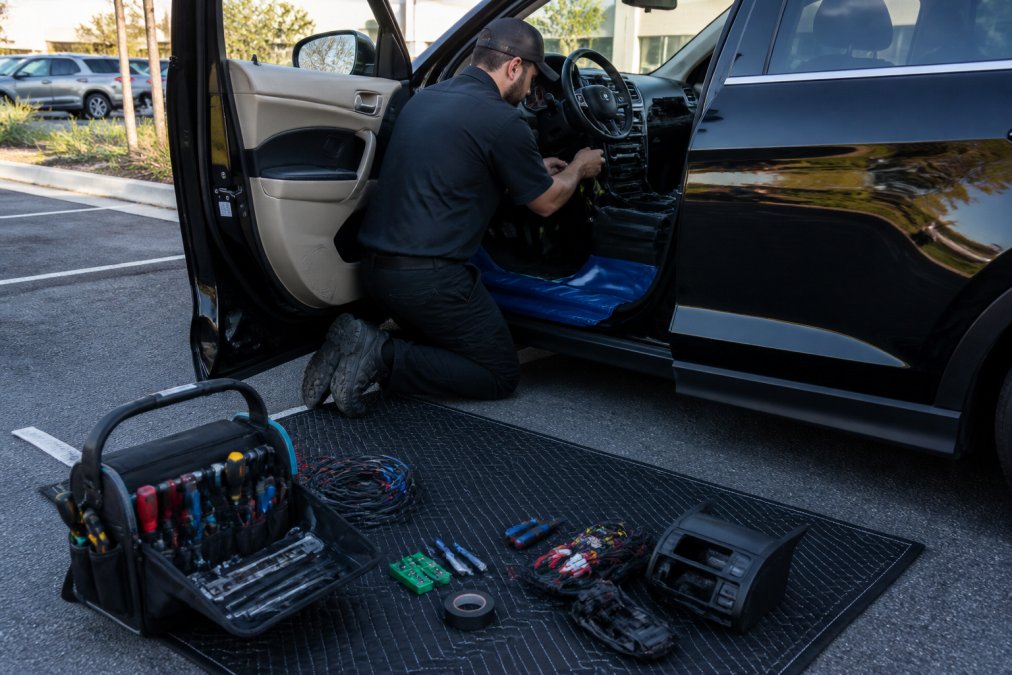
A mobile technician does not need a garage, but the vehicle must be positioned so both front doors can open fully and the trunk or hatch can swing clear. That typically means:
- A level, paved surface. Gravel, sloped driveways, and soft ground make it unsafe to jack or kneel under a panel, and they make trim removal harder to control.
- Roughly 10 feet of clearance on the driver's side and 6 feet on the passenger side. Door panels on most vehicles need to swing wide before they can be lifted off their clips.
- Shade or overhead cover when possible. Direct summer sun heats interior plastics until trim clips get brittle and makes adhesive-backed components harder to seat. A carport, parking garage, or even the shaded side of a building is enough.
- A nearby outlet within reach of a 50-foot extension cord. Many mobile setups run on battery tools, but a head unit flash, amplifier bench test, or laptop-based firmware update may need AC power. If no outlet is available, tell the provider when you book so they can bring a power station.
How Scheduling Actually Works
Most mobile providers book in two- to four-hour windows rather than exact appointment times, because the job before yours can run long. A few patterns hold:
- Morning slots (roughly 8 a.m. to noon) are the most reliable for complex work, because the technician is fresh and has daylight to spare if the job runs over.
- Office-parking-lot appointments are common and work well for jobs under three hours. The technician works while you're at your desk and texts you when the car is ready.
- Home appointments suit longer jobs, full system installs, amplifier and subwoofer work, multi-speaker replacements, where the car can sit for most of a day.
What You Should Have Ready Before the Technician Arrives
A few minutes of prep on your end saves time on theirs:
- Clear the vehicle. Remove car seats, gym bags, phone mounts, and anything on the dash or in the door pockets so the technician can move freely around the interior.
- Empty the trunk or cargo area if the job involves an amplifier, subwoofer, or rear speakers.
- Have the radio's security code ready if your factory head unit uses one. Many older units lock after a battery disconnect and will not power back on without it.
- Note the symptoms in writing. When the fault happens, what it sounds like, and whether temperature or bumps affect it. A written description is faster and more accurate than reproducing the problem on the spot.
- Disable any aftermarket alarm or remote start that could trigger while panels are off, and hand over the key fob rather than a valet key if the vehicle uses one.
Weather and Rescheduling
Mobile work happens outdoors in most conditions, but heavy rain, high wind, and temperatures below freezing can push a job to a later date. Reputable providers will call ahead if the forecast threatens the appointment. If your only workspace is uncovered, ask about the weather policy when you book, some reschedule at no charge, others work under a pop-up canopy if you have one.
Confirm four things when you book: the appointment window, the expected duration, whether the technician needs an electrical outlet, and the weather-reschedule policy. Getting these right upfront prevents most scheduling surprises.
Warranty Coverage and Follow-Up After a Mobile Install
Warranty coverage separates a professional mobile service from a fly-by-night operation. Ask two questions before booking: what does the workmanship warranty cover, and for how long? It should cover the installation itself, meaning if a connection fails or a panel rattles loose, the provider returns to fix it.
Frequently Asked Questions
How much does it cost to repair a car stereo with a mobile service?
Pricing depends on the fault, the parts needed, and whether the technician has to remove the dashboard or run new wiring. A loose connection or blown speaker costs far less than a head unit swap with a wiring harness adapter. Mobile car audio repair quotes usually bundle the service call into the total, so ask for an itemized estimate before you book and confirm whether the trip fee is waived if you approve the work.
Can a mobile technician integrate Apple CarPlay into an older vehicle?
Yes, in most cases. Vehicles from the mid-2000s onward usually accept an aftermarket head unit with a vehicle-specific dash kit and wiring harness. The technician keeps your steering wheel controls and factory amplifier working through an interface module. Very old or unusual dash layouts may need a custom trim piece, which adds time. Ask the technician to confirm fitment for your exact year, make, and trim before the appointment.
What should I look for when hiring a mobile electronics professional?
Check for verifiable installation experience, a real business address, and a written warranty on both labor and parts. Ask how they protect your electrical system, what happens if a fuse blows or a module throws a code, and whether they carry liability coverage. A technician with decades in the trade will walk you through the install plan before touching the car and will show you the finished wiring rather than hiding it behind the dash.
Do mobile car audio services provide warranties on their installations?
Reputable mobile providers back their labor with a written warranty, typically separate from the manufacturer warranty on the head unit, amplifier, or speakers. Get the coverage window in writing and ask whether a return visit for a loose connection is free. If a shop refuses to put warranty terms in writing, treat that as a warning sign. A 40-year-old company stakes its reputation on coming back when something needs attention.